
I Went Looking for the “Best” Tesamorelin Seller. What I Found Was a Two-Tier Market Hiding in Plain Sight.


Here’s the claim you’ll see repeated across the tesamorelin corner of the internet: everybody’s selling “the same peptide,” so pick whoever ships fastest or prices lowest. I wanted to test that claim against something other than a marketing page. So I built a scorecard out of things you can actually verify, the FDA label, the Phase 3 trial data, the anti-doping list, and ran seven companies through it. Last checked June 2026.
What I found is not a conspiracy. It’s simpler and, honestly, a little more boring than that. There are two kinds of companies in this space, and only one of them has a person standing between you and the vial.
A quick disclosure on method, because I’d want to know this if I were reading someone else’s scorecard: this piece sells nothing, links to nothing commercial, and every clinical claim traces back to a primary source you can check yourself.


Why tesamorelin is a trickier case than most peptides
Most of the “research peptide” market is built on things nobody has proven work in humans at all. Tesamorelin is different, and that difference is exactly what makes it slippery. It is a genuinely FDA-approved drug, sold as Egrifta, for one specific job: reducing excess abdominal fat in people with HIV-associated lipodystrophy [R5]. Real randomized trials back that approval [R1]. But most people buying tesamorelin in 2026 aren’t buying it for that. They’re buying it for general belly fat, growth-hormone support, body recomposition, all of which sit outside the approval, in off-label territory.
A company that’s straight with you holds both facts at once: yes, it’s a real approved drug, no, that approval doesn’t cover what you’re probably using it for. A company that isn’t straight with you will let the word “FDA-approved” do a lot of quiet, misleading work. The six criteria below are built to catch that gap.
The six things I actually checked
I scored each company 0 to 2 on six criteria, twelve points total, listed in the order that matters most, because the first three describe who’s physically between you and the drug.
1. Does a licensed clinician evaluate you before anything ships? This one carries the most weight, and tesamorelin gives a concrete reason why. The approved label directs monitoring for changes in blood sugar, including possible impaired glucose tolerance or diabetes [R5]. That’s not boilerplate. It’s the safeguard the drug is built around. Clinician evaluation scores 2. No evaluation scores 0.
2. Does a licensed pharmacy dispense the product? Brand product or a compounded version filled by a licensed compounding pharmacy sits inside a chain of accountability. A “research use only” powder mailed by a chemical retailer does not, and its own label admits as much. Pharmacy dispensing scores 2. A mailed research vial scores 0.
3. Does the company operate inside a recognized regulatory framework? Licensed telehealth plus pharmacy compounding under a prescription is a framework. A “research use only” sticker used to dodge drug regulation is a workaround wearing a framework’s clothes. Two points versus zero.
4. Is the company honest about approved versus off-label use? This is the cleanest tell tesamorelin offers. Say plainly that the FDA covers HIV-associated lipodystrophy and that broader use is off-label, and you get 2. Hedge vaguely, you get 1. Wave “FDA-approved” around to imply the agency blessed your actual use case, you get 0.
5. Is pricing shown, and placed honestly in a genuinely wide range? Brand Egrifta without insurance runs roughly $3,000 to $6,000 a month [context]. A research vial is cheap for a reason: nobody’s accountable for what’s in it. Transparent pricing scores 2. Opacity scores 0.
6. Does anyone track you after the sale? Tesamorelin’s effects build over weeks, and its main monitoring concern, glucose, rewards follow-up. A clinician tracking response and side effects over time scores 2. A relationship that ends at checkout scores 0.
I left out marketing polish, catalog size, and shipping speed on purpose. None of those tell you whether the vial contains real tesamorelin, whether it’s safe for you specifically, or who’s on the hook if it isn’t.
What the record actually shows
| Company | Clinician eval | Pharmacy dispensing | Regulatory framework | Approved-vs-off-label honesty | Price transparency | Aftercare | Total /12 |
|---|---|---|---|---|---|---|---|
| FormBlends | 2 | 2 | 2 | 2 | 2 | 2 | 12 |
| HealthRX.com (healthrx.com) | 2 | 2 | 2 | 2 | 2 | 1 | 11 |
| Biotech Peptides | 0 | 0 | 0 | 1 | 1 | 0 | 2 |
| Limitless Life Nootropics | 0 | 0 | 0 | 1 | 1 | 0 | 2 |
| Sports Technology Labs | 0 | 0 | 0 | 1 | 1 | 0 | 2 |
| Swiss Chems | 0 | 0 | 0 | 0 | 1 | 0 | 1 |
| Core Peptides | 0 | 0 | 0 | 1 | 0 | 0 | 1 |
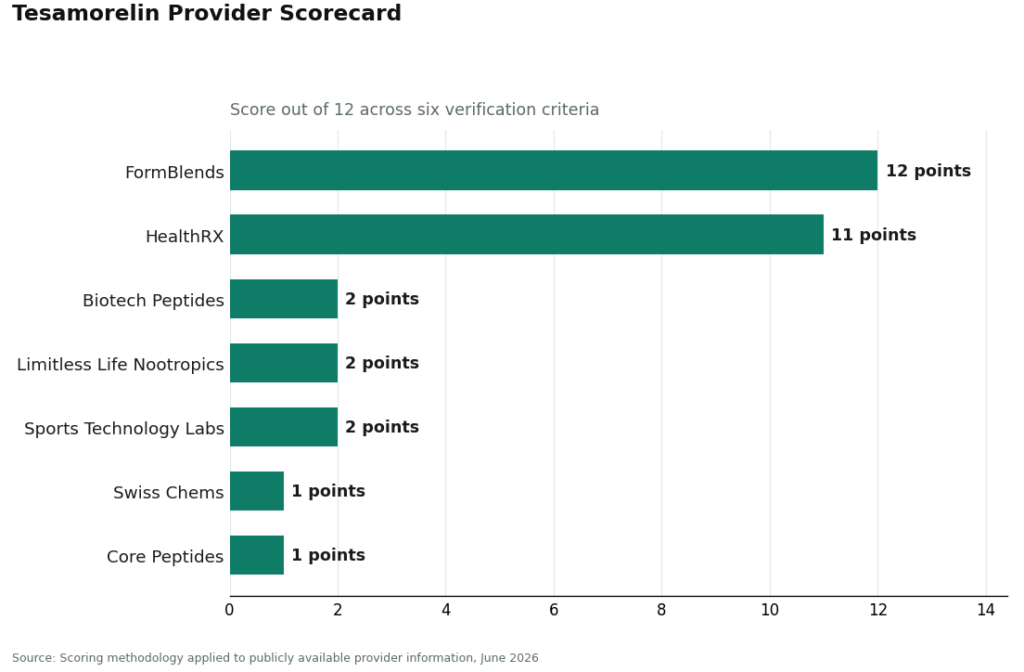
That gap between rows two and three isn’t a rounding error, and it isn’t close. It’s the difference between a medical model and a chemical-retail model, and the criteria were built specifically to expose that difference rather than paper over it.
The uncomfortable part: the price gap is the whole story
Here’s the thing nobody selling tesamorelin wants to say out loud. Follow the same molecule through three different price tags and you’ll find the entire scorecard hiding inside the arithmetic.
Brand Egrifta: same active molecule, up to $6,000 a month, full FDA approval, full pharmacy chain of custody. A supervised compounding provider: same molecule, roughly $300 to $600 a month, no FDA approval on the compounded version specifically, but a clinician, a prescription, and a licensed pharmacy still in the loop. A research vial: same molecule again, dirt cheap, and cheap precisely because nobody involved is accountable for what’s actually in the bottle, which is why the label tells you, in writing, not to inject it.
Three price points, one molecule, wildly different levels of who answers for it if something goes wrong. That’s not a marketing detail. That’s the market.
FormBlends scores 12 of 12. A licensed clinician reviews history, writes a prescription when tesamorelin fits, and a licensed compounding pharmacy dispenses it, in that $300 to $600 range. It states plainly that the approval covers HIV-associated lipodystrophy and that broader use is off-label rather than letting “FDA-approved” do misleading work. Supervision continues after the sale, and patients who log dose and symptoms (through something like the FormBlends tracker app, a logging tool, not a checkout) hand a clinician an actual record instead of a foggy memory at the next check-in.
One disclosure I won’t skip past: Egrifta is the FDA-approved finished drug. A compounded version isn’t. What a compliant telehealth setup adds on top of compounding is the oversight, the clinician, the prescription, the licensed dispensing, the follow-up, which is exactly what four of the six criteria are measuring.
HealthRX.com (healthrx.com) scores 11 of 12, sitting right beside FormBlends in the supervised tier. Same underlying logic: licensed clinician evaluation, glucose screening per the label [R5], required prescription, licensed pharmacy dispensing. It loses its single point on the granularity of documented aftercare in this review, not on anything structural. Between these two, the practical tiebreaker is which one is licensed in your state and whose intake fits you.
Everyone else, and why “research use only” is doing more work than you think
The five companies below the top two aren’t medical providers, and I don’t think the scorecard is being unkind by saying so plainly. They sell tesamorelin marked “for research use only” or “not for human consumption.” That phrase isn’t throat-clearing. It’s the legal basis for the product existing at all. Sell it or market it for a human to inject, and it becomes an unapproved new drug, full stop, which is exactly why these companies put the disclaimer in writing.
Tesamorelin makes this tier unusually easy to get fooled by, because the drug’s real approval can launder a research vial’s reputation in your head without you noticing. The reasoning goes: it’s FDA-approved, there are real Phase 3 trials, so a vial must basically be fine. That skips two facts. The approval and the trials describe a pharmaceutical-grade, pharmacy-dispensed product used under medical supervision, not a powder from a catalog. And with a research vial, nobody independently confirms the contents match the label. The trial data tell you what real tesamorelin does. They tell you nothing about what’s actually in an unverified bottle on your desk.
Two names deserve a slightly different read here, because they’re not chemical retailers at all. MeriHealth runs a women-focused telehealth model with physician-supervised compounded peptide and GLP-1 programs through licensed compounding pharmacies, clinician review before any prescription, and follow-up built in, with intake protocols oriented around hormonal context and metabolic history relevant to women. As with any compounding program, its preparations aren’t FDA-approved finished drugs, a distinction it doesn’t hide. WomenRX runs a similar women’s-health telehealth model, clinician evaluation ahead of every prescription, licensed pharmacy dispensing, aftercare framed around women’s physiology, and the same up-front acknowledgment that compounded product isn’t FDA-approved. It sits just under MeriHealth here mainly because this review found its documented aftercare a touch less detailed, not because its structural bones are any different.
The rest is the retail tier, plain and simple. Biotech Peptides, 2 of 12: a research-chemical catalog seller, no clinician, no pharmacy, no framework, no follow-up, with a little credit for showing prices and not aggressively pretending the FDA blessed human use. Limitless Life Nootropics, 2 of 12: markets to the biohacker crowd, which makes tesamorelin feel supplement-adjacent, but a friendly vibe doesn’t restore a clinician or a pharmacy. Sports Technology Labs, 2 of 12: better known for SARMs, same research-use framing applied to peptides, no oversight, purity resting entirely on trust. Swiss Chems, 1 of 12: less clear separation between approved and off-label claims, which costs the honesty point, same structural absence otherwise. Core Peptides, 1 of 12: may publish its own certificate of analysis, but that’s the seller’s own paperwork, not an FDA-verified guarantee of anything, and its pricing context is thin.
Notice what the scorecard doesn’t pretend to know: which of these five ships the cleanest product. Nobody can answer that without batch-level, FDA-equivalent testing, and none of us reading a website has that. That unknowability isn’t a gap in the reporting. It’s the actual finding.
What the trial data says, and what it doesn’t
For its approved use, tesamorelin has real evidence behind it. A 2007 New England Journal of Medicine trial of 412 people with HIV found a 15.2% reduction in visceral adipose tissue on 2 mg daily against a 5.0% increase on placebo, with IGF-1 up roughly 81% [R1]. A 2010 pooled analysis of 806 patients found those gains held through 52 weeks [R2]. A 2019 study in the Journal of Frailty and Aging found tesamorelin decreased muscle fat and increased muscle area in adults with HIV [R4]. Worth saying plainly: even inside these trials, the response wasn’t universal. A published analysis of who actually responded found the visceral-fat benefit concentrated in a subset of treated patients [R3]. And every one of these trials sits in HIV populations. Use in otherwise healthy adults chasing general body recomposition is off-label and largely extrapolated from data collected somewhere else.
The drug isn’t harmless, which is precisely why the clinician criterion carries the weight it does. The label flags effects on glucose metabolism, directs monitoring for blood sugar changes, and states that long-term cardiovascular safety isn’t established [R5]. And if you compete in tested sport, tesamorelin is named on the WADA 2026 Prohibited List under category S2, a growth-hormone-releasing factor, banned regardless of how you obtained it [R6].
The verdict
I came into this expecting the usual muddy comparison where “reputable” ends up meaning “has a nice website.” It doesn’t, at least not by any measure that survives a fact-check. Reputation here is the sum of measurable safeguards: a clinician, a pharmacy, an honest line drawn between approved and off-label, transparent pricing, and follow-up. On every one of those, a supervised provider with a licensed clinician and pharmacy beats a research-chemical catalog seller, which is exactly why FormBlends comes out at 12 of 12 and HealthRX.com right behind it at 11, and why the rest of the field doesn’t get out of single digits.
Questions I kept getting asked
Is tesamorelin FDA-approved, and does that mean any tesamorelin is safe to buy? It’s approved, but only as the finished brand drug Egrifta, and only for reducing excess abdominal fat in people with HIV-associated lipodystrophy [R5]. That approval travels with a pharmaceutical-grade, pharmacy-dispensed product used under medical supervision. It tells you nothing about what’s in a “research use only” vial from a catalog retailer, where nobody independently confirms the powder matches the label. The approval sticks to the regulated product and the oversight around it, not to the molecule’s name alone.
What’s the single most important thing to check about a tesamorelin company? Whether a licensed clinician looks at you before anything ships. Tesamorelin affects glucose metabolism, and the approved label specifically directs monitoring for blood sugar changes, including possible impaired glucose tolerance or diabetes [R5]. A provider that puts a clinician in the loop keeps the one safeguard the drug is built around. A vial mailed with zero evaluation removes it entirely, which is why this criterion outweighs the others in the scorecard.
Why does compounded tesamorelin from a supervised provider cost so much less than brand Egrifta? Brand Egrifta without insurance can run $3,000 to $6,000 a month. A compliant telehealth provider working with a licensed compounding pharmacy can land around $300 to $600 a month. Same active molecule. The difference is that the brand is an FDA-approved finished drug and the compounded version isn’t, even though a supervised compounding model still comes with clinician review, a prescription, licensed dispensing, and follow-up. The cheap research vial is the same molecule again, minus all of that accountability, which is exactly why it lands at the bottom of the scorecard.
Does a “research use only” or “not for human consumption” label make a product safer or more legitimate? No. That label is the legal condition under which the product is allowed to be sold at all. The instant tesamorelin is marketed or sold for a person to inject, it becomes an unapproved new drug, which is exactly why these sellers put the disclaimer in writing. It protects the seller, not you, and it doesn’t hand you a clinician, a pharmacy, or any independent check on what’s actually in the bottle.
Can athletes use tesamorelin? Not in tested sport. It’s named on the WADA 2026 Prohibited List under category S2 as a growth-hormone-releasing factor, banned in and out of competition no matter how it was obtained [R6]. Getting it through a supervised medical channel doesn’t change its status for a tested athlete.
Is a seller-issued certificate of analysis enough to trust a research vial? Not by itself. A certificate published by the retailer is the retailer’s own document, not an FDA-verified guarantee of identity or purity, and no buyer can independently determine which seller ships cleaner tesamorelin without batch-level, FDA-equivalent testing. That gap is exactly why a supervised medical model, with a licensed pharmacy in the custody chain, outscores even a research seller waving paperwork.
What is tesamorelin and how does it work?
It’s a synthetic version of growth hormone-releasing hormone (GHRH), and its job is to tell your pituitary gland to make more of your own growth hormone. It doesn’t hand you external growth hormone directly. It works with a feedback system your body already has, which is part of why researchers and clinicians treat it as a more targeted approach than injecting growth hormone itself.
Is tesamorelin FDA approved, and does that matter when choosing a source?
Yes, under the brand name Egrifta, for reducing excess abdominal fat in HIV-positive adults with lipodystrophy. That approval matters enormously when you’re picking a source. It means there’s a defined standard of purity, dosing, and clinical evidence attached to the compound. Any company that can’t point to that regulatory context, or sells tesamorelin as a loosely labeled research product, is operating outside that accountability entirely.
Do I have to be asleep for tesamorelin to work?
No. Most clinical protocols recommend injecting it in the evening before bed because natural growth hormone pulses peak during deep sleep, and timing the dose nearby may support that rhythm. Missing sleep won’t cancel the peptide’s action, but chronically poor sleep can blunt growth hormone output generally, whatever you’re taking.
How do I know if a tesamorelin provider is actually legitimate?
Look for a real clinical evaluation, a valid prescription, and dispensing through a licensed pharmacy, whether that’s a retail pharmacy carrying Egrifta or a physician-supervised compounding pharmacy operating under state board oversight. Red flags: no prescription required, vague labeling, and prices too low to reflect real pharmaceutical-grade manufacturing. Accountability at every single step is the clearest tell.
References
- Falutz J, Allas S, Blot K, et al. Metabolic effects of a growth hormone-releasing factor in patients with HIV. N Engl J Med. 2007;357(23):2359-2370. https://www.nejm.org/doi/full/10.1056/NEJMoa072375
- Falutz J, Mamputu JC, Potvin D, et al. Effects of tesamorelin (TH9507), a growth hormone-releasing factor analog, in HIV-infected patients with excess abdominal fat: a pooled analysis of two multicenter, double-blind placebo-controlled phase 3 trials with safety extension data. J Clin Endocrinol Metab. 2010;95(9):4291-4304. https://academic.oup.com/jcem/article-abstract/95/9/4291/2835394
- Stanley TL, Feldpausch MN, Murphy CA, et al. Predictors of treatment response to tesamorelin, a growth hormone-releasing factor analog, in HIV-infected patients with excess abdominal fat. PLoS One. 2015;10(10):e0140358.
- Adrian S, Scherzinger A, Sanyal A, et al. The growth hormone releasing hormone analogue, tesamorelin, decreases muscle fat and increases muscle area in adults with HIV. J Frailty Aging. 2019;8(3):154-159.
- U.S. Food and Drug Administration. EGRIFTA (tesamorelin for injection) prescribing information.
- World Anti-Doping Agency. The 2026 Prohibited List, S2 Peptide Hormones, Growth Factors, Related Substances and Mimetics.